Ancient Rome during the Republic




This is an introduction to ancient Rome during the Republic. A number of separate sections support with further detail through time:
The Roman Republic, The Republic in crisis and Julius Caesar and the end of the Republic.
READ MORE

With the expulsion of Tarquin the Proud and hence of Etruscan influence over Rome the first Consuls were elected. The Roman republic hence began in the year of Lucius Iunius Brutus and Lucius Tarquinius Collatinus – 509BC.
This coincided with the beginning of a long period of social discontent between classes between Patrician upper class (who had exclusive control of the Senate) and Plebeian lower class (who lived by the laws of the Senate). This soon lead to the creation of new institutional positions with the aim of giving the Plebeians a say in government: although they weren’t allowed to vote and participate in the debates at the Senate they were given a power of veto. This veto was expressed through elected “Tribunes of the People”.
Not even 20 years into the Republican era Rome entered the Latin league (a sort of pact of alliance with the neighbouring populations which the Romans eventually walked all over).
In the year 451BC the army was reorganised into centuries. In the same year the council of ten decemviri was created and the twelve tablets of law were written and published in public areas such as the Forum for all to see and learn.
In 445BC laws are passed to permit marriages between plebeians and patricians.
By 396BC the neighbouring Etruscan town of Veio was taken and destroyed (actually it was colonised by Romans). Six years later Rome itself was taken by the Gauls, the negative effect of this was short lived as Rome soon picked up its expansionist activities but it did bring about the destruction of many historical records. Aparently the Palatine itself was never taken but the whole event is shrouded in myth – for example the betrayal of Tarpeia who let them in, the geese of Rome waking up the sentries to save the city etc.
In 367BC the plebeians won the right to nominate their own consul and soon after the right to run for important political/administrative positions.

Rome’s growth plans soon put them into conflict with their Latin allies. 343-341BC they began the gruelling Samnite wars (the Samnites were a neighbouring population). The Latin league was undone soon after (338BC). They lost the second but won the third and last Samnite war (290BC).
Having taken control of the southernmost tip of Italy there was only one way to go: take the whole of Sicily and then across the Mediterranean to north Africa. The people of the port city of Tarentum in Sicily called king Pyrrhus of Epirus for assistance (280BC, look at the map left and you will see Epirus just across the Adriatic coast in Greece). The common phrase “Pyrrhic victory” says much of how events went during the following five years. Sicily finally fell into Roman hands.
This lead on to a direct clash with the powerful Carthaginians and started the so called “Punic wars“. By the end of the second Punic war in 201BC Rome took control of the Mediterranean and in 146BC Carthage was finally razed to the ground.

The growth of influence across Italy, to the islands and conflict with the mighty naval power of the Greeks and Carthaginians provided strong impetus for the Roman Republic to improve Roman ships and naval technology.
About the same time Greece and Macedonia fall into Rome’s lap (146BC), Corinth was destroyed.
Whilst all the above was going on to the south, Rome took Sardinia and Corsica in 238BC, Cisalpine Gaul (the bit around the Alps) in 222BC and Spanish provinces (197BC).
In 130AD the Asian province was created, but continued success in war and the continuous flow of wealth into Rome did little to resolve public discontent. This was largely because the wealth wasn’t being fairly distributed. The Patricians invested their war winnings in huge land tennancies, leaving little if anything for the poor plebeians. At least the slaves could work the fields and survive (albeit in frightful conditions).
The Tribune of the People Tiberius Gracchus attempted to force the introduction of a series of agrarian laws in favour of the plebeians but was assassinated before getting them through. It has to be said that he resorted to rather illegal methods in order to achieve his objectives but you might even argue he had little alternative. His brother Caius Gracchus gave it a second shot in 119BC but also got killed. Some eighty years had to pass until Julius Caesar would finally take a despotic approach (he was dictator by then) and enforce the agrarian laws in favour of the poorer classes.
Between 121 and 125BC southern Gaul was taken.
General Marius takes command of the army, reforms it and uses it to save Roman dominions from marauding Germanic tribes (102-101BC)
91-88BC social discontent spreads to Rome’s allies (the so-called Social Wars) and in the end they are granted the right to Roman citizenship.

General Marius and his leftenant Sulla (or Silla) become the prime actors of civil war, Marius takes Rome then Silla takes it, Marius dies and Silla becomes dictator (82BC), reforms the constitution and gives the Senate its powers back. Silla hence writes huge proscription lists of all Marius’ allies and offers cash rewards, as a consequence of which close to 5000 Roman citizens are hunted down and killed. Julius Caesar who was related to Marius narrowly escapes being put to death. Silla dies in 78BC. Julius Caesar eventually has Marius’ war trophies restored.
63BC – Cicero thwarts the Catiline conspiracy.

60BC – The up-and-coming Caesar becomes co-ruler with Crassus and Pompey in the first “triumvirate” which was in reality an informal arrangement but so rich and powerful as to supercede the power of the Senate. Roman dominions were essentially cut up into three slices each ruled by one of the triumvirs. Caesar set off for conquest, riches and glory: he took Gaul (58-51C) and then moved on for Germany and Britain but whilst in Britain his daughter Julia who was married to Pompey dies, thus dealing a heavy blow to the alliance. Crassus died in battle and so Pompey and Julius Caesar are left alone and at odds.
In 52BC Pompey has himself elected consul and allignes himself with the Senate against Julius Caesar. Caesar is ordered to disband his army but he refuses and enters Italy with his men – “Alea Jacta Est”. The civil war begins (49BC).

The Senators and Pompey flee Rome without a fight and make for the port of Brindisi from whence they leave Italy for Greece. In Greece they plan to rally. JC catches up and is almost beaten in battle except he is saved by Pompey’s retreat. Battle of Pharsalus sees Pompey the Great beaten – he flees to Egypt but is treacherously murdered by the Pharoah who thinks that by so doing he would win Caesar’s favour without risking the possible future wrath of Pompey. Caesar is said to have wept and to have removed the Pharoah in favour of the pharoahs sister later known as Cleopatra (VII). Pompey’s supporters and the last vestiges of republicanism were finally defeated at Munda in 45BC. Caesar committed adultery and had a son with Cleopatra.
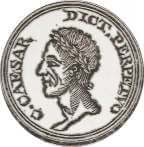 In february 44BC Caesar is named dictator for life. He initiates much needed reforms and public works but was stabbed to death by Crassius, Brutus and others on the ides of March (15th March 44BC).
The power gap left by Caesar was promptly filled by the murderers who wished to hand power back to the Senate but Caesar’s friend and leftenant Marcus Antonius was quick to rally public sentiment against them and in so doing took a considerable amount of power himself, including much needed consent of Caesar’s troops. Unfortunately Caesar’s written will left power to his nephew Octavian (aka Emperor Augustus). A triumvirate is set up but soon falls apart leaving Octavian with power in Italy and Europe vs. Mark Anthony and his consort Cleopatra (and her son with Julius Caesar remember).
Intrigue ensues but to cut a long and dramatic story short (see the film Cleopatra with Elizabeth Taylor and Richard Burton) all is resolved at the final battle of Actium which leaves Octavian sole ruler of Roman dominions. More than a genius of arms he is a true genius of propaganda: Octavian carefully and cleverly proclaims himself Emperor without raising negative public opinion and slowly but surely establishes absolute power for himself. He is given the honorary title “Augustus” by the Senate who also name the month of August after him.
History of Rome: | The Origins of Rome | The seven Kings of Rome | The Conquest of Italy and the Punic Wars | The Republic and social struggle | The Republic in crisis | Julius Caesar and the end of the Republic | Augustus and the Empire | The Julio Claudian dynasty | The Five Good Emperors | Other Emperors | Emperor Constantine and Christianisation |Fall of the Roman Empire of the West |
Aspects of Rome: | Religion and Mithras | Schools | Literature | Games, Sport and Pass-times | Food | Social Structure and Class | Government & Law |Shopping | Economy of Ancient Rome | Roman Coins | Building and Engineering | Art | Dress and Clothing |Early Christianity | The Gladiators | Gory Martyrdoms | The Vestal Virgins |
Designed by VSdesign Copyright ©Maria Milani 2017
Please email us if you feel a correction is required to the Rome information provided.
Please read the disclaimer
"Ancient Rome" was written by Giovanni Milani-Santarpia for www.mariamilani.com - Ancient Rome History
Designed by VSdesign Copyright © Maria Milani 2017