Ancient Roman Mosaics



Ancient Roman mosaics complemented Roman painting both in terms of pictorial effects as well as in terms of their function in Roman architecture: Elements of Roman buildings, Roman houses, and paving. The great benefit of mosaics with respect to paintings was the greater durability and vibrancy of colour, so much so that in many cases there will be little left of an excavated villa but the mosaic on the floor may well be close to intact.
READ MORE
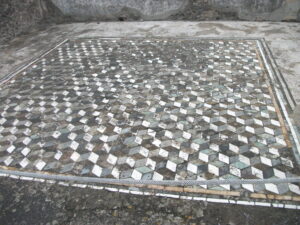
Amazing examples of ancient Roman mosaics have been found in multiple locations for example at Hadrian’s villa (bowl with doves, over 60 tesserae per square cm). The mosaics in the House of the Faun in ancient Pompeii, the villa at Piazza Armerina in Sicily and of the wonderful examples such as at Antioch (3rd Century AD) give a sense of their durability, importance, richness, and variety.
The level of detail and finesse achieved was extraordinary and the amount of work required to achieve high quality could make their cost quite prohibitive. At the bottom end of the scale, but also requiring great time and patience we have mosaics employed for covering floor spaces in a durable yet elegant way. Between these extremes, we have the multitude of mosaics used in everyday situations, in public places, shops, houses, gladiator training schools and so on.
When dealing with ancient Roman mosaics it is tempting to simply run through the chronology, type, and level of achievement but a second look will show that we can go a step further: Roman mosaics are a significant facet and indicator of the evolution of ancient Roman art and as such display many of the evolutionary twists and turns of Roman society itself.
Ironically, understanding this statement about Roman mosaics in a little more detail requires us to approach the subject as a mosaic with many components rather than linearly like a chronological piece of storytelling though clearly, we can’t do without looking at timing and development as well as construction methods also.
Before we delve into an overview of Roman mosaics and their development through time it is worth running through the table below to get a preview of some of the elements which went into creating the many different examples of mosaics which have survived from ancient Rome and therefore how Roman mosaics reflect use and society of the time. Appreciating these aspects helps us understand the evolution and significance of mosaics in ancient Rome.
Art in ancient Rome was very much a case of commission. A commission could be for public purposes such as political propaganda, a public bath, or even for private use be it of plebeians, merchants or rich noble people. There was a direct relationship between the means available and the resulting mosaic.
Roman mosaics had numerous possible functions:
Modulating the composition and type of mosaic could reach amazing heights of skill as is shown in the varied mosaics of the villa at Piazza Armerina in Sicily which were structured according to the type of physical movement a person might have in the given space.
Mosaics could be for public or private viewing. Shop or trades guild versus palace, magistrate’s court or public baths. It could be a private room like a bedroom or a dining room or reception hall. Roman mosaics were used to reinforce Roman social structure and the social position of those who commissioned them.
For example, the general plebeian public in the Pantheon would be over-awed by the sense of space and the unique divine position of the emperor standing on a podium, surrounded by statues of the Roman divinities and placed in relation to the heavens (the hole at the top of the dome). The floor enhances the sense of space by a modular opus sectile technique which through its repetitive geometric pattern reflects the shape of the temple and at the same time enables a sense of size with respect to the individual.
On the other hand a rich merchant or upper class person in Pompeii might have invested in a central highly ornate “emblema” where light from the impluvium would have shown it in its best light and attracted the viewer (his clients) to the middle of the reception room, from where they would then get the best impact of the frescos on the walls, paintings and rich furnishing around the room.

A large range of materials was used for ancient Roman mosaics including pebbles, pieces of terra cotta tiles, pumice stone and seashells through to precious stones, marbles of various provenance and even coloured glass and gold leaf. Pumice and shells might be used to decorate a nymphaeum whilst pottery and marble inserts in a cement matrix were often used in Republican period floors which were both durable and attractive.


when considering the mosaic as a component of Roman architecture, there were three main compositional approaches:
The images shown are drawn from mosaics in Roman tombs underneath the Vatican (St.Peter’s Basilica)

Roman mosaic with a functional purpose
The theme of mosaics was often in keeping with the type of use in the room within which it was situated.
Plain: including plain monotone black or white, possibly with a frame of opposite colour around the edge. We might include the republican period flooring of cement with pottery sherds and marble inserts. Durable, “clean” and refined. Larger pieces might be used for faster work.
Geometric patterns: most frequently in black and white tesserae of “opus tesselatum” although could also be in coloured marble slabs of “opus sectile”. The geometric pattern might have a modular composition repeated across the entire floor space or be generally plain with a central geometry which might give some sort of optical effect of 3D or of false movement.
Figurative: As with the geometric patterns the image might stretch across an entire floor or be constrained to a central insert called “emblema”. The central piece might be either bought ready made or constructed on site by local artisans. The same occurred with painting. The purchased pieces were often replicas of famous works and could reach a high level of skill and complexity. They might be compared to the trade in copies of artwork and/or sculpture.
within the figurative genre, we should also consider the type of image depicted as this is indicative of the type of Roman art we would be dealing with: Mythological scenes were frequently of Graeco-Roman influence and more closely associated with the Roman elite and political agendas (and hence included mosaics for public display). Roman plebeian art, on the other hand, was a steady current in Roman art and more closely associated with scenes of everyday life, such as those which might be shown on a shop floor or a funeral memorial stone.
Roman mosaics developed along a number of parallel streams: Durable walking surface, architectural spacial element, ornament. In artistic terms Roman mosaics followed a path parallel to that of Roman Painting and Roman art, transferring to the horizontal plane artistic problems which were essentially pictorial. The real difference between the two being that mosaic, by its nature, drives towards divisionism with its issues similar to those of impressionism in the 19th century and indeed to those of modern pixelated digital images: Greater effort and energy is required to store and produce a high-resolution colour image, whilst a geometric pattern in two tones and with larger pieces (fewer pixels) can be greatly simplified. As the image becomes greater in size so the effort and resource required increases exponentially. The very physical nature of mosaic reinforced its relation to architecture and to marble inlay (opus sectilis) which slowly made its way from floors and skirting boards to decorate further up the walls as in Nero’s Domus Aurea in the 1st century and the Basilica of Junius Bassus in late antiquity.
The art of ancient Roman mosaics was essentially inherited through southern Italy and Sicily from Greece and developed to a high degree driven by the wealth and desire of display by the Romans who could afford to commission them. It achieved strong impulse through the conquest of Greece in the 2nd century BC though there are many fine examples of mosaic in Italy well before that date. In fact, the oldest extant examples of mosaic found are from the Greek bronze age in Crete around 2500-1400BC after which the art seems to have been lost. The Greeks themselves probably re-learned mosaic art from the Orient in the 8th Century BC where in northern Siria and Asia Minor a variety of geometric shapes were being laid out in variously coloured stones. During the 7th century BC, they spread through areas such as Sparta and Crete in public buildings and then became a mainstream technique in Greek art and throughout the Mediterranean basin.
4th century pebble mosaic from Pella in Greece

At first mosaic work was restricted to the laying of coloured river pebbles in a uniform manner. Wonderful examples of this technique dating back to the 4th century BC have been found at Pella in Macedonia (see the image), the city where Alexander the Great was born and where the art achieved its greatest heights.
Within Italy a number of pebble mosaics have been found at Arpi in SE Italy which also date back to the 4th century BC: This italic city had a variety of influences and eventually absorbed as a Roman dominion in the 3rd century BC. Another example of Italian mosaics from the 4th/3rd are the mosaics at Mozia in Sicily: a Carthaginian city with Greek influence. The art of pebble mosaics continued in popularity in the Orient, including also far regions like Afghanistan right through to the 2nd century BC.
The mosaics found at the Montarozzi area of Arpi give a virtuoso display of the varied techniques which developed through the 4th to 3rd century BC: small pebbles become irregular surfaces and eventually regular cubes. By breaking the pebbles a flatter surface could be achieved and the individual pieces were refined to the cubes we are accustomed to. Roman mosaics of this sort were known as “opus tesselatum”.

Whilst Pliny confirms Roman belief that mosaics originated in Greece, the Greek writer Athenaeus Naucratis who lived in Roman Egypt during the 2nd century AD seems to confirm that Sicily was the place where particular advances were made, mentioning marvelous floors with images of the Iliad made of tesserae (“abakiskoi”) given as a present by the ruler of Syracuse to Ptolemy III.
A decorative pattern on a shop floor or many public areas was often two-tone (black and white) though there are plenty of wonderful examples of black and white mosaics laid in ancient Roman houses, luxurious villas, rich tombs and public buildings such as Romal thermal baths. By the 2nd century BC, coloured mosaics reached a degree technical perfection in central Italy as local artisans had increased contact with the Greek influence of the southern Greek colonies such as Naples, Pompeii, Syracuse and indeed with Greece itself.
It may be a gross over-simplification but by and large, we can closely associate coloured highly figurative work with Graeco-Orientalising influence and the black and white mosaics with the Roman-Italic current of art. Very gross generalisation!

This loss of centrality within ambient space made mosaic yet more aligned with the needs of architecture where the appreciation of space is generally acquired through movement around it. The mosaics at Piazza Armerina in Sicily (early 4th century AD) are a perfect example of this correlation between the composition of mosaics, the layout of the internal spaces and the movement of individuals through them.

An average sized ancient roman mosaic piece (tessera) would be about 1cm square though over the centuries great extremes were reached either side of that from pieces as small as a few millimetres to as large as individual coloured marble tiles (opus sectilis). The surface aspect also had multiple solutions: highly polished and uniform surfaces would give a result similar to a varnished painting, often used in highly refined detailed works like those found in Hadrian’s villa whilst slight surface differences could be used to achieve an effect closer to a matte surface, catching and scattering light in a multitude of directions – Cosmatesque work of the middle ages is a wonderful example of how this can be put to use where ambient light is low and diffused.
Complexity was at its greatest when the image of the mosaic was in colour(s). In this case, the tesserae would not only have to describe form but also the pattern of different tonal/colour shades within this form. The finest of effects would be achieved with the smallest of tesserae in pretty much the same way that a computer screen can give a more or less perfect image according to the number and size of the pixels per square inch it is capable of displaying. In the most extreme of cases, this could require as many as 300 tesserae per square inch (50 per square centimeter) and countless numbers of different coloured marbles, stones and glass, each piece being cut on site.
The range of colours available depended on the range of marbles and coloured stones available. Coloured glass paste could also be used as a material and was generally employed, together with marble, in works of higher prestige. Often the materials used were recycled, especially in later periods of the empire when the cost of marbles and loss of power made them difficult to obtain. Roman mosaics such as that on the ceiling of a vault in the Nero’s Domus Aurea are the first to include the use of gold leaf on glass to extend the colour range further than ever.
We can therefore imagine the vast range of effects, labour and cost required in order to produce a single mosaic. Generally speaking, it is difficult to categorise the style of mosaic work as clearly as has been done with paintings. Linear and abstract styles were often evolved in parallel with different styles of figurative colour work. The height of this art was achieved in the Roman provinces of northern Africa where mosaics were created in every sense similar to an intricate painting of “the fourth style” (see the section on Roman frescoes and painting). Small and detailed leaves, animals, portraits and figures all interwoven into a “carpet” of marble.
At the poorer end of the scale, we have mosaics which verged on tiling. Small terracotta tiles of various geometric shapes such as squares and diamonds would be laid to create an overall pattern and only a number of these would have a single marble tessera inserted into them. This required little if any true “mosaic” work to be done in order to achieve a satisfactory and durable patterned surface.
Designed by VSdesign Copyright ©Maria Milani 2017
Please email us if you feel a correction is required to the Rome information provided.
Please read the disclaimer
"Ancient Rome" was written by Giovanni Milani-Santarpia for www.mariamilani.com - Ancient Rome History
Designed by VSdesign Copyright © Maria Milani 2017